

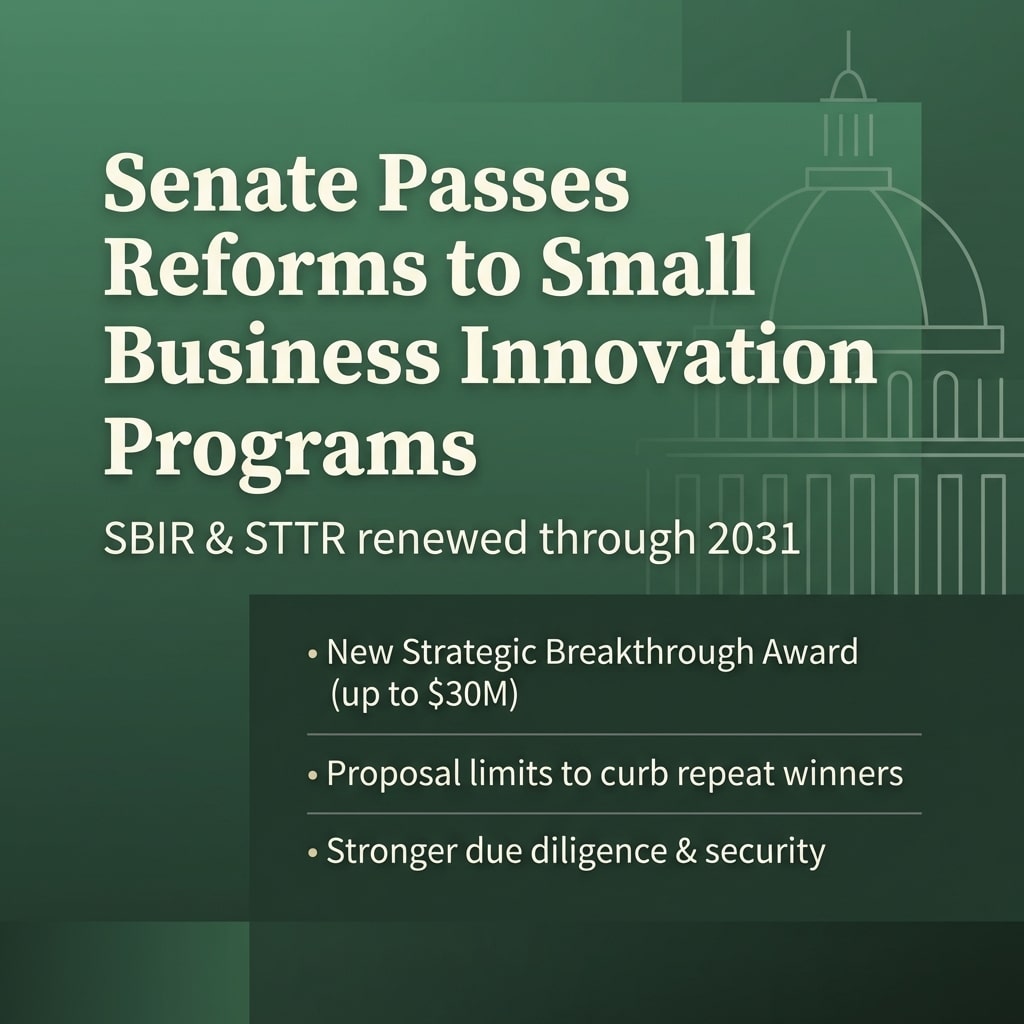
The U.S. Senate on March 3 unanimously passed the Small Business Innovation and Economic Security Act (S. 3971), restarting two federal programs that channel billions of dollars in R&D seed funding to small technology companies. The bill now heads to the House of Representatives.
The legislation extends the Small Business Innovation Research (SBIR) and Small Business Technology Transfer (STTR) programs through September 30, 2031. Both programs had been frozen since their authorization lapsed on October 1, 2025, leaving more than 4,000 companies a year without access to new awards.
SBIR and STTR, sometimes called “America’s Seed Fund,” require 11 federal agencies to set aside a share of their research budgets for competitive grants to small businesses. Typical Phase I awards run $150,000 to $250,000 and Phase II awards run $750,000 to $1 million, according to Bloomberg Government.
The compromise was led by Senate Small Business Committee Chair Joni Ernst (R-Iowa) and Ranking Member Ed Markey (D-Mass.) after months of contentious negotiation. The most divisive proposal, a $75 million lifetime cap on awards per company, was dropped from the final text.
In its place, the bill requires each agency’s SBIR office director to set annual limits on how many proposals a single company can submit. Agency directors can waive the cap on a topic-by-topic basis for time-sensitive or national security needs, but waivers are limited to 5% of topics per year. The intent is to prevent larger, entrenched firms from crowding out smaller applicants.
The bill also creates a new Strategic Breakthrough Award track with grants up to $30 million over 48 months, funded from up to 0.5% of each large agency’s extramural R&D budget. Eligibility is strict and generally requires a prior Phase II award plus 100% matching funds from non-SBIR sources, as reported by Breaking Defense.
Foreign-risk screening gets tougher. Every application will be evaluated against due-diligence checks, applicant disclosures, and national security watchlists. Relationships with entities linked to the Chinese government face heightened scrutiny.
Small businesses that paused SBIR planning during the 5-month freeze should start getting proposals ready now. Agencies will need time to reopen offices, draft new topic announcements, and restart review panels, but an accelerated solicitation schedule is expected before the fiscal year ends in September. Companies should also review new foreign-entity disclosure requirements and cybersecurity documentation.
The bill moves next to the House, where passage is widely expected. If signed into law, agencies could begin issuing new solicitations within weeks.
