
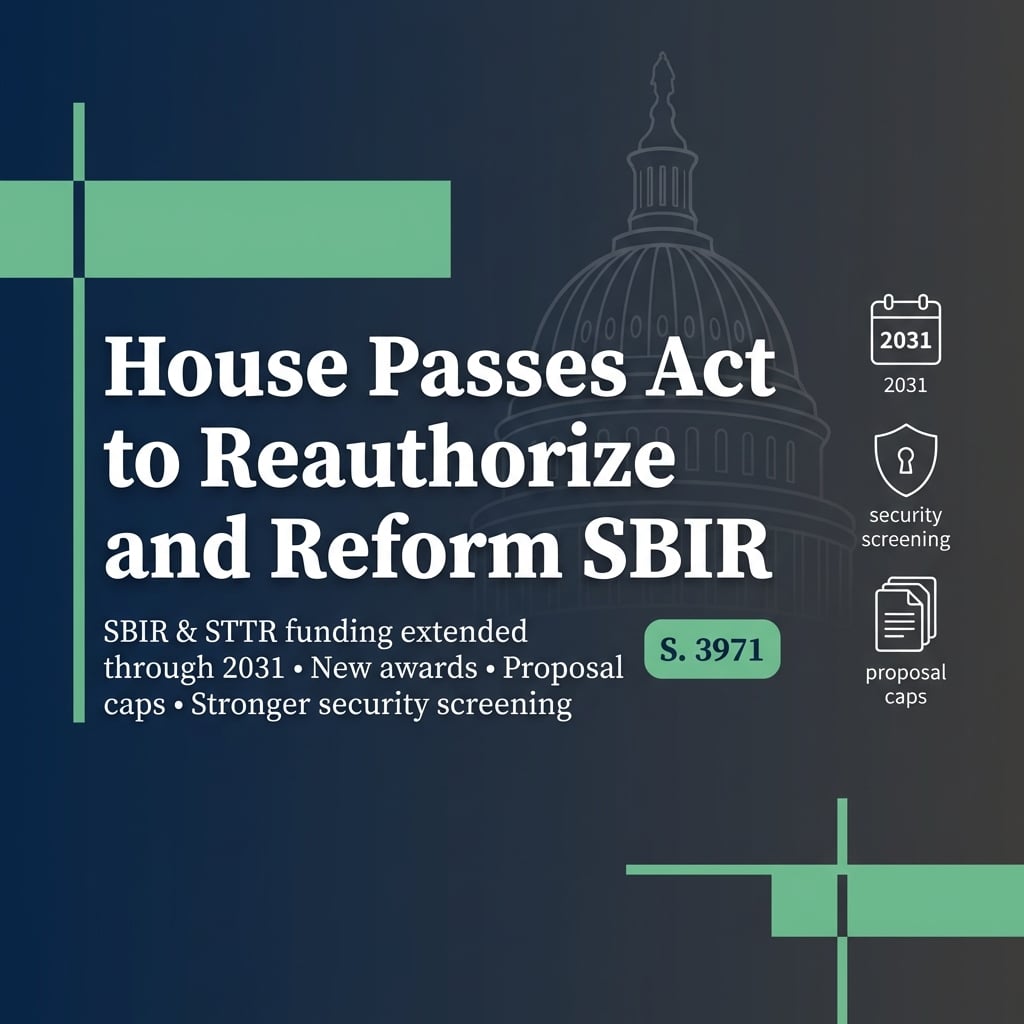
The U.S. House of Representatives passed the Small Business Innovation and Economic Security Act (S. 3971) on March 17, 2026, by a vote of 345 to 41. The Senate had already passed the bill unanimously on March 3, and the House followed on March 17 with a 345-to-41 vote. The bill now awaits presidential action.
When signed, the nation’s largest dedicated innovation pipeline for small businesses will restart through September 30, 2031. That is a roughly 5.5-year authorization window, replacing the stop-and-go 3-year cycles that caused repeated funding disruptions.
More than 3,700 U.S. small businesses will continue to have full access to more than $4 billion in SBIR and STTR funding every year. The programs had been frozen since October 2025 after Congress failed to reauthorize them before their September 30 expiration.
This is not a simple extension. New award categories, mandatory submission caps, enhanced security screening, and expanded technical assistance provisions will reshape how small businesses compete for federal innovation funding.
A new Strategic Breakthrough Award allows agencies to award up to $30 million per award or series of awards over 48 months. Applicants should begin planning for the 100% matching-funds requirement, particularly given the emphasis on new capital. Prior Phase II award history is also required.
The reauthorization introduces mandatory due diligence requirements across eight federal watchlists, and agencies must evaluate applicants across six dimensions including cybersecurity practices, foreign ownership, key personnel foreign affiliations, and patent portfolios. Businesses with foreign ties should assess their exposure now.
Agencies will establish caps on the number of proposals a single applicant may submit per fiscal year, reflecting a concern that high-volume submissions strain agency review capacity and crowd out other competitors. This means every proposal slot will carry more strategic weight.
One wrinkle remains. The bill’s final step may not be immediate, as President Trump has stated that he will not sign any legislation until Congress passes the Save America Act. However, the President has 10 days (excluding Sundays) to sign or veto, and if no action is taken while Congress remains in session, the bill automatically becomes law.
Small businesses that rely on SBIR/STTR grants should use this window to document their cybersecurity practices, review ownership structures for foreign connections, and prepare proposals. DOD and NIH are expected to publish the first new solicitations under the reauthorized programs in April or May 2026, with NSF, DOE, and NASA following through mid-year. Details on the bill are available from the official Congress.gov page and a thorough legal breakdown from Goodwin Law.
