

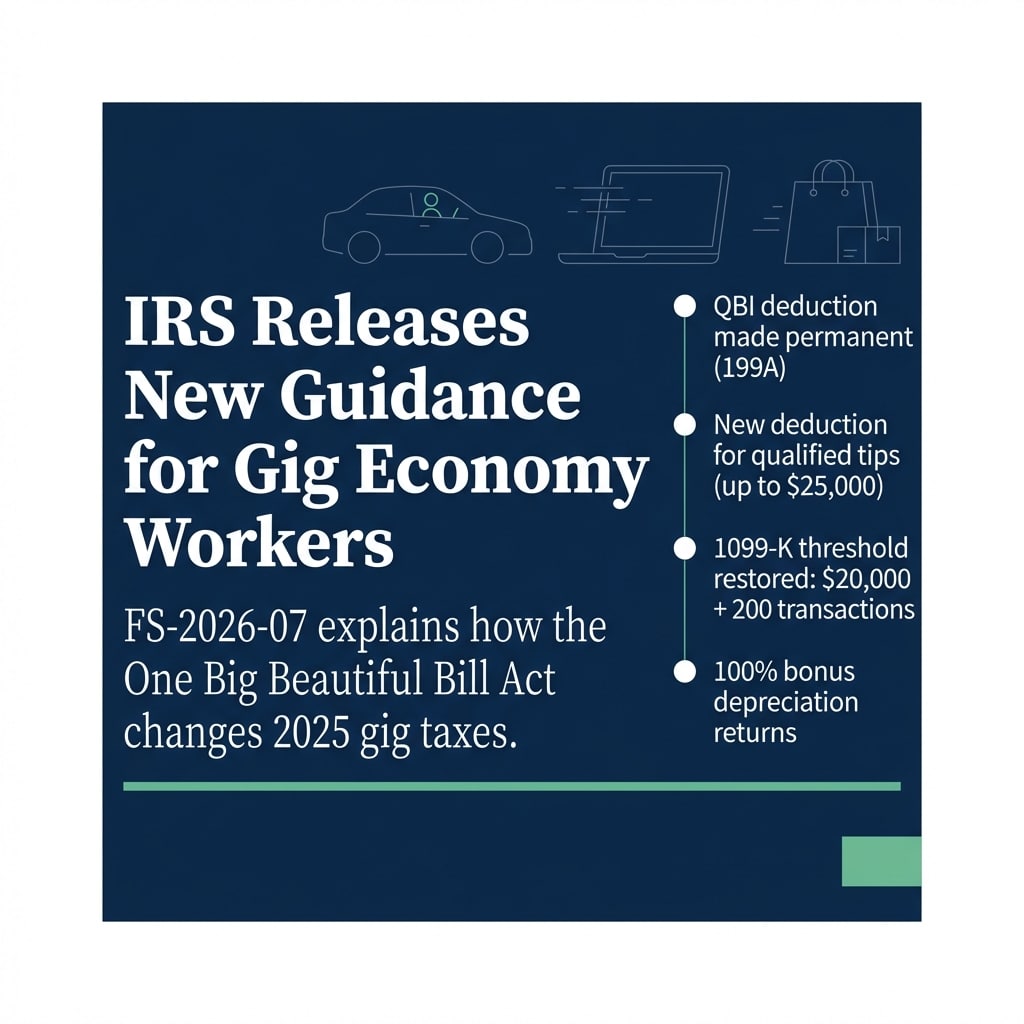
The IRS released Fact Sheet FS-2026-07 in March 2026, spelling out how the One Big Beautiful Bill Act (signed into law on July 4, 2025) changes the tax picture for gig economy workers. If you drive for a rideshare app, freelance, rent property through a platform, or do any other independent contract work, this guidance is worth your attention.
What changed
The Qualified Business Income (QBI) deduction is now permanent. This is the Section 199A deduction that lets eligible self-employed workers deduct up to 20% of their net business income from their taxable income. Under the original 2017 Tax Cuts and Jobs Act, this break was set to expire after 2025. The new law removes that sunset, giving freelancers and small business owners more certainty for long-term planning.
A new deduction for qualified tips. Eligible gig workers can now deduct up to $25,000 in qualified tips per return from their taxable income. This applies for tax years 2025 through 2028. The IRS has proposed a list of nearly 70 tipped occupations that qualify. Self-employed workers need their tips reported on a Form 1099-MISC, 1099-NEC, or 1099-K to claim this deduction.
The Form 1099-K reporting threshold went back up. The law reversed the American Rescue Plan’s $600 threshold and restored the original rule. Payment platforms like PayPal, Venmo, and app-based marketplaces are now required to send a 1099-K only when payments exceed $20,000 and 200 transactions in a calendar year. That said, all gig income is still taxable and must be reported regardless of whether you receive a 1099-K.
100% bonus depreciation is back. Gig workers who buy qualifying business assets like vehicles or computers after January 19, 2025 can deduct the full cost in the year of purchase, as long as the item is used more than 50% for business.
What gig workers should do now
Check the IRS’s proposed list of qualified tipped occupations to see if your work qualifies for the $25,000 tips deduction. Keep detailed records of all business expenses and tip income. If you purchased equipment for your gig work after January 19, 2025, document your business-use percentage to support a bonus depreciation claim.
Remember that self-employed workers are responsible for paying both the employee and employer portions of Social Security and Medicare taxes, totaling 15.3% on net earnings. The IRS expects quarterly estimated tax payments throughout the year to avoid penalties.
The full fact sheet is available on the IRS website. The tips deduction runs through tax year 2028, and the IRS has not yet finalized its list of qualifying tipped occupations, so watch for updates before filing.
