

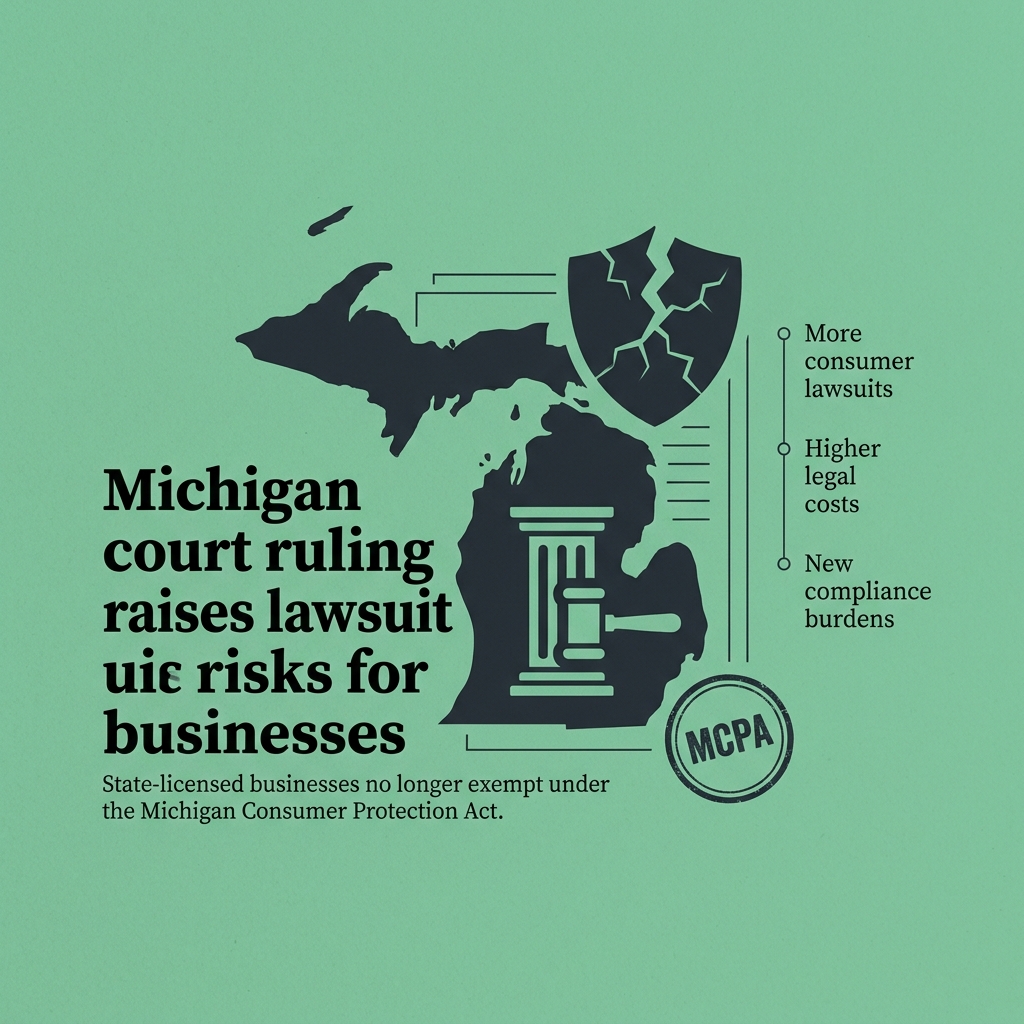
For more than 25 years, a Michigan barber, plumber, or auto dealer could point to a pair of state Supreme Court rulings and say, in effect, “I’m already regulated. You can’t sue me under the Consumer Protection Act.” On Friday, in a 4-3 decision, the Michigan Supreme Court overturned those two rulings, wiping out a legal shield that had blocked consumer lawsuits against businesses already overseen by a state or federal agency.
The court found the 1999 Smith v. Globe Life Insurance Co. decision and the 2007 Liss v. Lewiston-Richards ruling were wrongly decided because their broad interpretation did not match the plain language of the Michigan Consumer Protection Act (MCPA). Justice Noah Hood, writing for the majority, said those rulings “rendered much of the state’s consumer protection act unworkable.”
Who loses the shield
The Michigan Chamber of Commerce has warned that over 80 regulated industries and professions now face new litigation risks, from duplicate enforcement and inconsistent rulings to class actions, treble damages, and costly legal exposure. Previously blocked industries include nursing homes, construction companies, medical professionals, and pharmaceutical companies.
The MCPA bans “unfair, unconscionable, or deceptive” business practices and allows private lawsuits by consumers. Under the law, nearly every industry regulated by state and federal law can now be subject to MCPA lawsuits, which create additional avenues to class actions and the awarding of treble damages. For a small shop, a single treble-damages claim could dwarf the underlying dispute.
What small businesses should do now
The ruling takes effect immediately. Justice Hood acknowledged that the decision “may open the door to increased litigation brought against businesses operating in Michigan” but said that was not sufficient reason to keep the old precedents.
Business owners who hold any state license or operate under federal regulatory oversight should review their customer-facing practices with an attorney. Advertising claims, pricing disclosures, service agreements, and refund policies all become potential litigation targets under the MCPA’s broad prohibitions. Existing general liability or professional liability insurance may not cover consumer-protection claims, so checking with your carrier is a practical first step.
The Michigan Chamber has said that removing this exemption “would create uncertainty and increase costs, with ripple effects extending to small businesses, workers and consumers across Michigan’s economy.” The group had coordinated a coalition brief with 14 other trade associations urging the court to keep the exemption intact.
Separately, State Sen. Sam Singh, who introduced Senate Bill 134 to legislatively repeal the same exemption, called on the Republican-led House to pass his bill, signaling the Legislature may pile on with additional changes. Meanwhile, a companion House bill, HB 5725, was introduced to try to restore the exemption by statute.
The next battleground is Lansing. Whether the Legislature codifies the ruling, softens it, or leaves it alone will determine just how exposed Michigan’s licensed businesses remain heading into 2027.
