

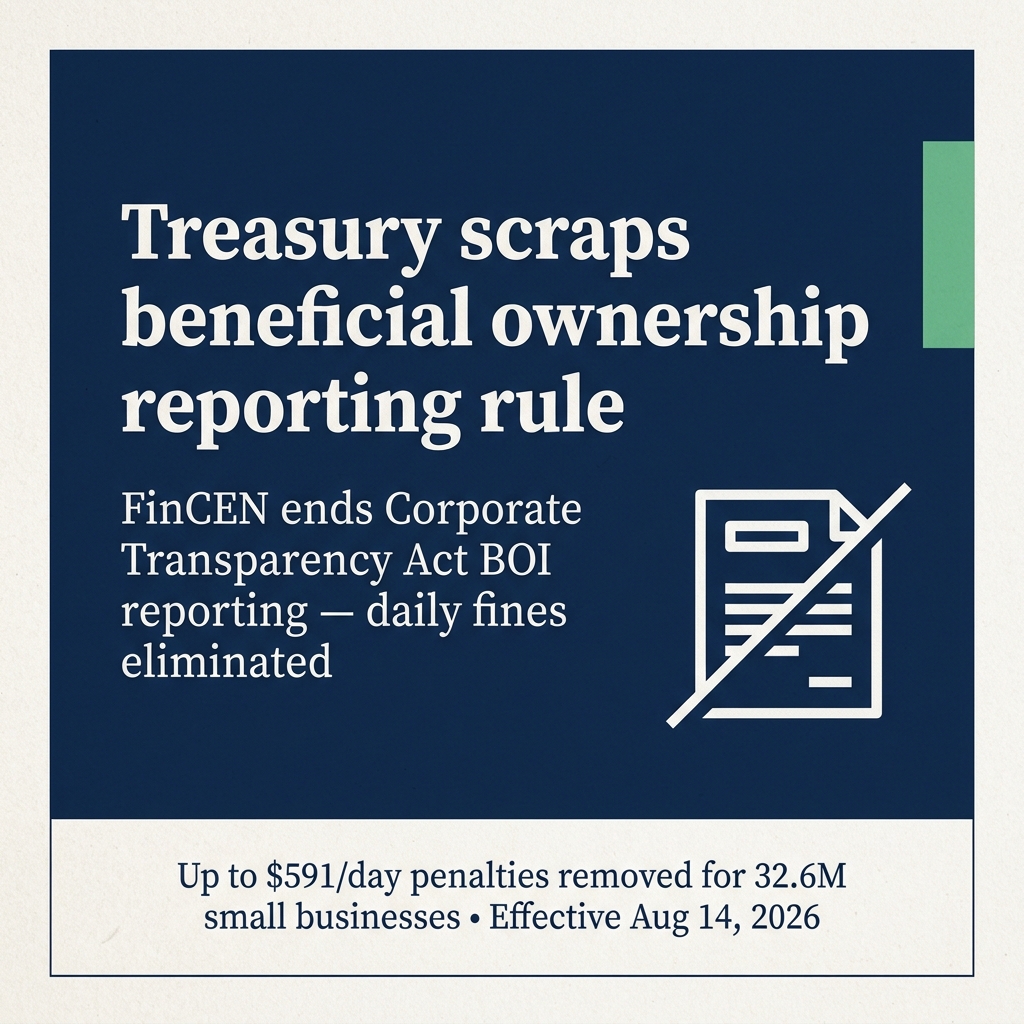
An estimated 32.6 million small businesses just lost a compliance headache that could have cost them $591 a day. FinCEN, the Treasury Department’s financial-crimes bureau, issued a final rule on August 11 that permanently kills the requirement for U.S. companies and their owners to report beneficial ownership information under the Corporate Transparency Act. The rule took effect August 14, 2026, when it was published in the Federal Register.
The Corporate Transparency Act, passed in 2021, was designed to crack down on anonymous shell companies used for money laundering and tax evasion. It required most LLCs, corporations, and similar entities to file detailed ownership reports, including names, birthdates, and addresses of anyone who controlled the business or held at least 25% of it.
Non-compliance was no joke. The law carried civil penalties of up to $591 per day for every day a violation continued, plus criminal fines of up to $10,000 and as much as two years in prison. For a sole proprietor who simply missed a filing, those daily fines could stack up fast enough to threaten the entire business.
A long road to the finish line
The rule’s path to the graveyard took over a year. Federal courts issued multiple injunctions in late 2024 and early 2025 halting enforcement. In March 2025, Treasury announced it would stop pursuing penalties against U.S. companies and issued an interim rule narrowing BOI reporting to foreign entities only. Tuesday’s final rule makes that rollback permanent.
Treasury Secretary Scott Bessent called the move “a victory for common sense and American small businesses,” adding that Treasury is “eliminating a burdensome reporting requirement for millions of law-abiding business owners.” Not everyone agrees. The Financial Accountability and Corporate Transparency Coalition warned the repeal “keeps the floodgates open for criminals to launder money through U.S. shell and front companies.”
What business owners need to know now
If your company was formed under U.S. state or tribal law, you do not need to file a BOI report. If you already filed one, you don’t need to do anything. FinCEN says it will delete previously reported data for U.S. persons from its database automatically.
Two caveats are worth noting. Foreign entities registered to do business in the U.S. must still report beneficial ownership information for their foreign individual owners. And the rule does not change banks’ existing obligations to verify who owns business accounts under separate customer due diligence rules, so your bank may still ask for ownership details when you open or update an account.
Small businesses that had been paying lawyers or compliance services to prepare BOI filings can stop. But owners with complex structures that include foreign entities should check with an attorney to confirm the exemption applies to every entity in their chain.
