

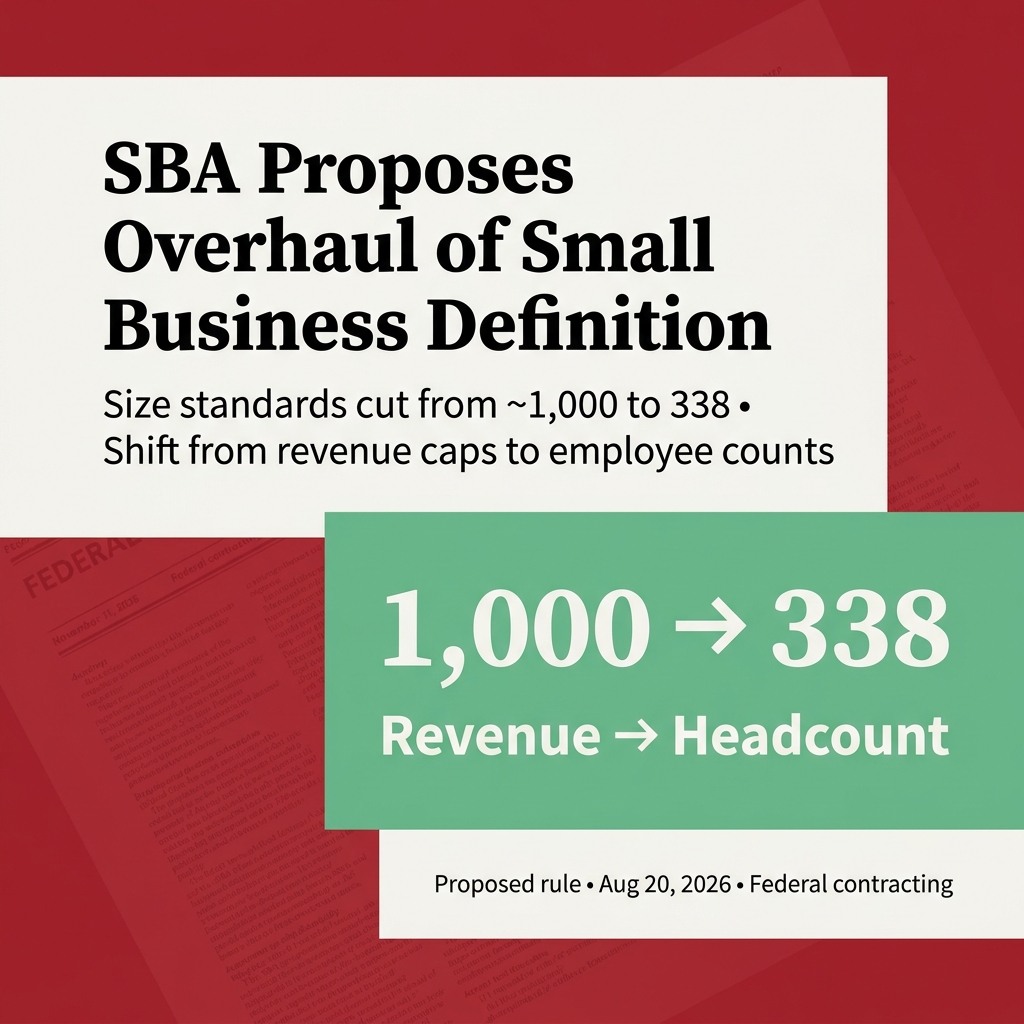
Nearly 1,000 separate thresholds define who counts as a “small business” for federal contracting. The Small Business Administration wants to cut that number to 338 and, in the process, flip the default yardstick from revenue to headcount.
Two proposed rules published in the Federal Register on August 20, 2026 lay out the biggest single rewrite of SBA size standards the agency has ever attempted. Instead of setting a separate size standard for each 6-digit NAICS code, SBA would group industries at the 4- or 5-digit level, producing 338 standards total. Of those, 208 would be employee-based and 129 would remain receipts-based.
Who gets redefined
Under today’s rules, industries like construction, retail, and professional services use a revenue cap. A commercial construction firm, for example, currently qualifies as “small” if its average annual revenue stays below $45 million. Under the proposed approach, that same firm could instead be measured by headcount. That shift matters because a company doing $100 million in revenue might still have fewer employees than the proposed threshold, letting it compete for set-aside contracts that were previously out of reach.
For truly small contractors, this is a competitive threat. Firms with 10 or 20 employees would find themselves bidding against much larger operations that now qualify as “small” too. The pool of eligible businesses could grow by tens of thousands of firms across affected industries.
What to do before September 21
SBA is accepting public comments on both the revised methodology and the proposed size standards until September 21, 2026. Business owners who rely on federal set-aside contracts or SBA loan programs should take a few steps now.
- Look up your primary and secondary NAICS codes and compare your current size standard to the proposed threshold for your industry group.
- Model how the switch from revenue-based to employee-based measurement would affect your eligibility, including affiliate headcount.
- If the new rules would hurt your competitive position, submit a comment through regulations.gov before the September 21 deadline.
This is still a proposed rule, not a final one. SBA will review comments and could revise thresholds, timelines, or the grouping methodology before anything takes effect. But the direction is clear. Last August, SBA proposed raising revenue-based caps across 263 industries. This new proposal effectively supersedes that earlier effort with a more fundamental restructuring.
Businesses near the edges of current thresholds, whether they stand to gain or lose eligibility, have 32 days to weigh in.
