

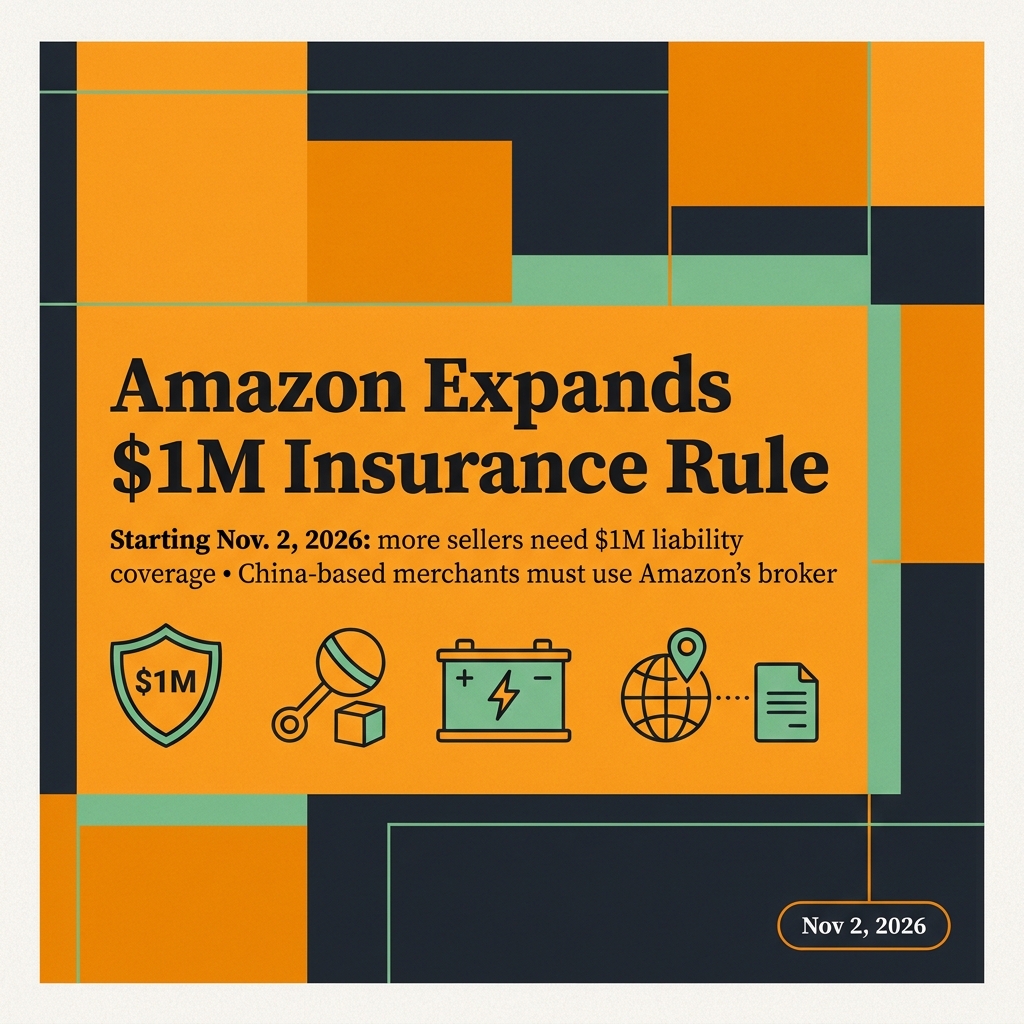
For years, a small Amazon seller could go without liability insurance until sales passed $10,000 in a month. As of November 2, 2026, that cushion is gone for anyone selling children’s products, cosmetics, supplements or lithium battery goods.
Amazon now requires sellers in categories with enhanced safety listing requirements to carry at least $1 million in commercial liability coverage, no matter how little they sell. The rule covers listings that are already live, not just new ones, according to Amazon’s official seller notice.
So a seller who sells a few toddler toys a month now needs the same coverage as a brand doing six figures. A single slow-selling listing in a covered category can pull the whole account in.
Who needs coverage now
Commercial liability insurance pays claims if a product injures someone or damages property. Amazon wants coverage of $1 million per incident and $1 million in total, according to its policy page.
- Children’s products
- Cosmetics and ingestibles such as supplements
- Lithium battery products
Amazon says these examples are not the full list, so sellers should check the complete category list in Seller Central. The old rule still applies to everyone else, who get 30 days to buy coverage after a month above $10,000 in sales.
China-based sellers lose their choice of insurer
The second change applies to sellers based in mainland China. They must now buy coverage through the Amazon Insurance Accelerator, a group of insurers Amazon put together with the broker Marsh, My Amazon Guy reports.
“Starting November 2, 2026, we will reject newly submitted insurance policies that are not obtained through AIA,” Amazon wrote. An outside policy that was valid and on file before that date can stay in use until it expires.
Sellers outside China can still pick any insurer that meets Amazon’s standards.
Enforcement may not show up right away. SellerEssentials says Amazon emails affected sellers and gives them 45 days to send proof, PPC Land reports. After that, listings in those categories can be turned off, while listings in other categories stay up.
Amazon hasn’t said what these policies typically cost, and prices will depend on the product and the insurer. Small sellers should get quotes now and compare the yearly premium with what each covered listing actually earns.
For some low-volume sellers, the math will point toward dropping a listing instead of insuring it.
