

A single warehouse fire in Boyle Heights burned for eight days, left 85 million pounds of food rotting in the open air, and triggered a state of emergency. Three months later, it has rewritten the rules for every large cold storage operator in California.
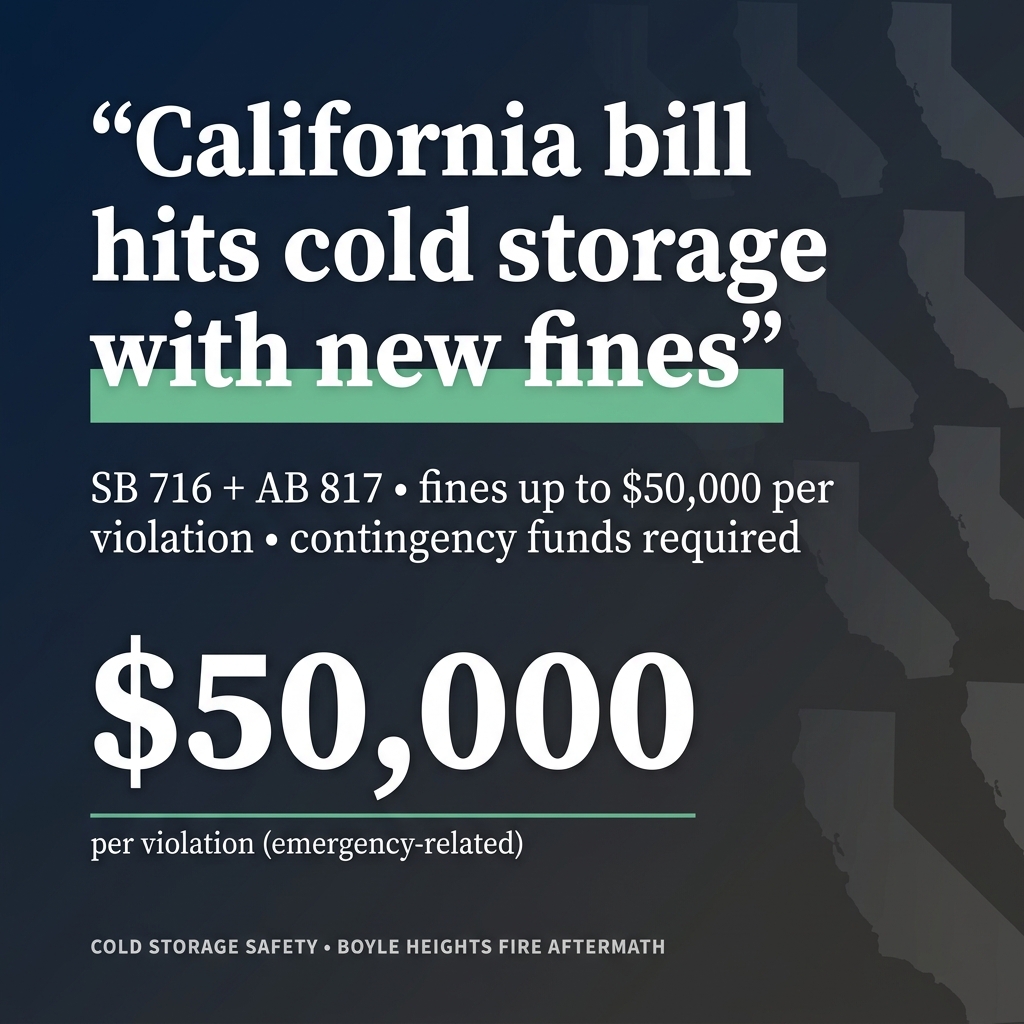
On September 27, 2026, Governor Gavin Newsom signed SB 716 and AB 817 into law. Together, the two bills impose escalating fines for health and safety violations at nonresidential buildings of 20,000 square feet or more and force new cold storage facilities to set up contingency funds before they can even pull a building permit.
Fines that actually sting
Under SB 716, local governments can now hit violators with a $1,000 fine for a first offense, $2,000 for a second violation of the same ordinance within five years, and $5,000 for each additional repeat. When a violation contributes to a governor-declared emergency or a federal disaster declaration, that figure jumps to $50,000 per violation.
The enhanced penalties apply in Los Angeles County right away and expand statewide starting July 1, 2028. Certain building types and facilities in areas with lower pollution burdens under the state’s CalEnviroScreen rankings are exempt.
A new pre-permit hurdle
AB 817 adds a different kind of cost. Any new cold storage facility above roughly 20,000 square feet must establish a contingency fund, capped at $20 million, or secure equivalent insurance before a city or county will approve a building permit. That money is earmarked for community needs during emergencies, including housing assistance, food aid, air quality monitoring, and healthcare.
Until July 1, 2028, the contingency-fund rule applies only within the Boyle Heights Community Plan area. After that date, it goes statewide.
For small businesses that rely on third-party cold storage for perishable goods or pharmaceuticals, the downstream effects are real. Higher compliance costs for operators will likely flow through as increased storage fees, rent adjustments, or surcharges. Reviewing cold storage contracts now for cost-sharing clauses is a practical first step.
Senator María Elena Durazo, who authored SB 716, pointed to the June disaster’s toll on residents. The Lineage Logistics fire at a nearly 500,000-square-foot facility on June 17 exposed families to toxic smoke and the stench of decomposing food for months.
Industry groups, including the Global Cold Chain Alliance, have warned that these requirements will raise costs across California’s food and pharmaceutical supply chains and could discourage facility expansion. Local governments still have wide discretion over how large the contingency fund must be within the $20 million cap, leaving uncertainty for operators trying to budget new projects.
Small cold storage operators and businesses planning new builds should watch for implementation guidance from county agencies in the coming months, particularly in Los Angeles County, where both laws take effect first.
