

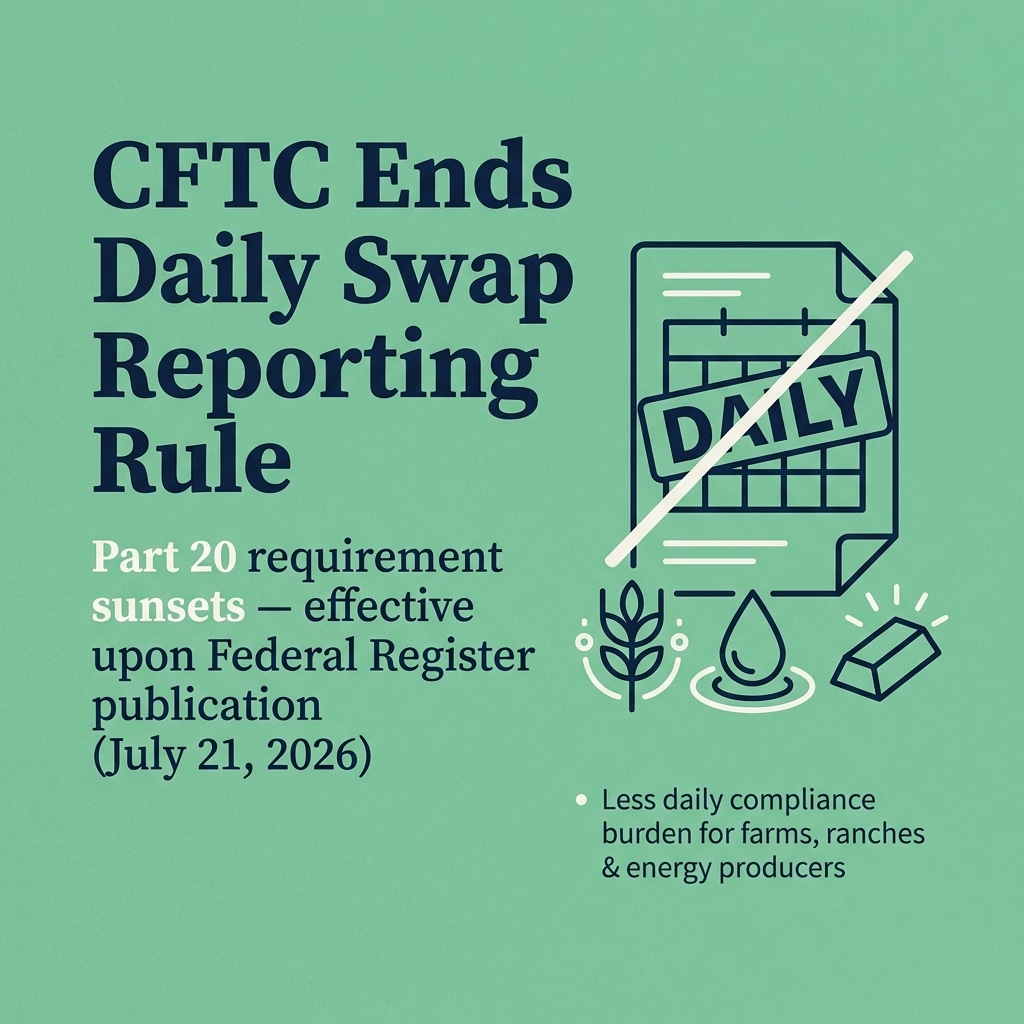
For more than a decade, swap dealers, clearing members, and clearing organizations dealing in physical commodity swaps have filed daily position reports with the Commodity Futures Trading Commission under a rule that was always supposed to be temporary. This week, it finally goes away.
On July 17, the CFTC issued a final order sunsetting the routine large trader reporting requirements under Part 20 of its regulations. The order takes effect upon publication in the Federal Register, scheduled for July 21, 2026.
A 15-year “temporary” rule
Part 20 was adopted in 2011 as a stopgap after the Dodd-Frank Act while the CFTC built out its broader swap data reporting system. That system, codified under Parts 43 and 45, has been fully operational for years. Yet Part 20’s daily and event-based position reports kept rolling, layering on what industry groups called duplicative paperwork.
CFTC Chairman Michael S. Selig put it bluntly in the agency’s announcement. “American financial market participants should not be saddled with costly and duplicative reporting requirements that do not improve the quality of our regulation,” he said.
Trade associations SIFMA, ISDA, and FIA had pushed hard for this change. In a May 2026 joint letter, they noted that compliance with the Part 20 rules can run “well over $1 million” per reporting firm each year, and that sunsetting them “could save market participants tens of millions of dollars year over year.”
What stays in place
The CFTC is not walking away from oversight entirely. The agency is keeping Part 20’s recordkeeping and special-call provisions as a transitional measure. That means clearing members, swap dealers, and clearing organizations must still maintain records of their paired swap and swaption transactions and be ready to produce them if the CFTC asks.
Small businesses that use commodity swaps to hedge crop prices, fuel costs, or metals exposure will not see a direct paperwork change on their desks. The reporting obligation sat with their swap dealers and clearing members, not with the end-user. But the industry groups behind this push have argued that the cost of dealer compliance ultimately gets passed along in wider spreads and higher fees. Fewer compliance costs for dealers could, over time, mean cheaper hedging for their clients.
Importantly, the broader swap data reporting requirements under Part 45 remain fully in effect. Any business or dealer filing swap creation and continuation data to swap data repositories must keep doing so. This order only removes the Part 20 daily position reports, not the entire regulatory framework around swap transparency.
The final order is effective as soon as it hits the Federal Register on July 21. Small producers who hedge with swaps should confirm with their dealer or clearing member that the daily Part 20 filings have stopped and ask whether that changes any data the dealer has been requesting from them. The CFTC’s Agricultural Advisory Committee meets July 29, which may offer the first public forum for questions about next steps.
