

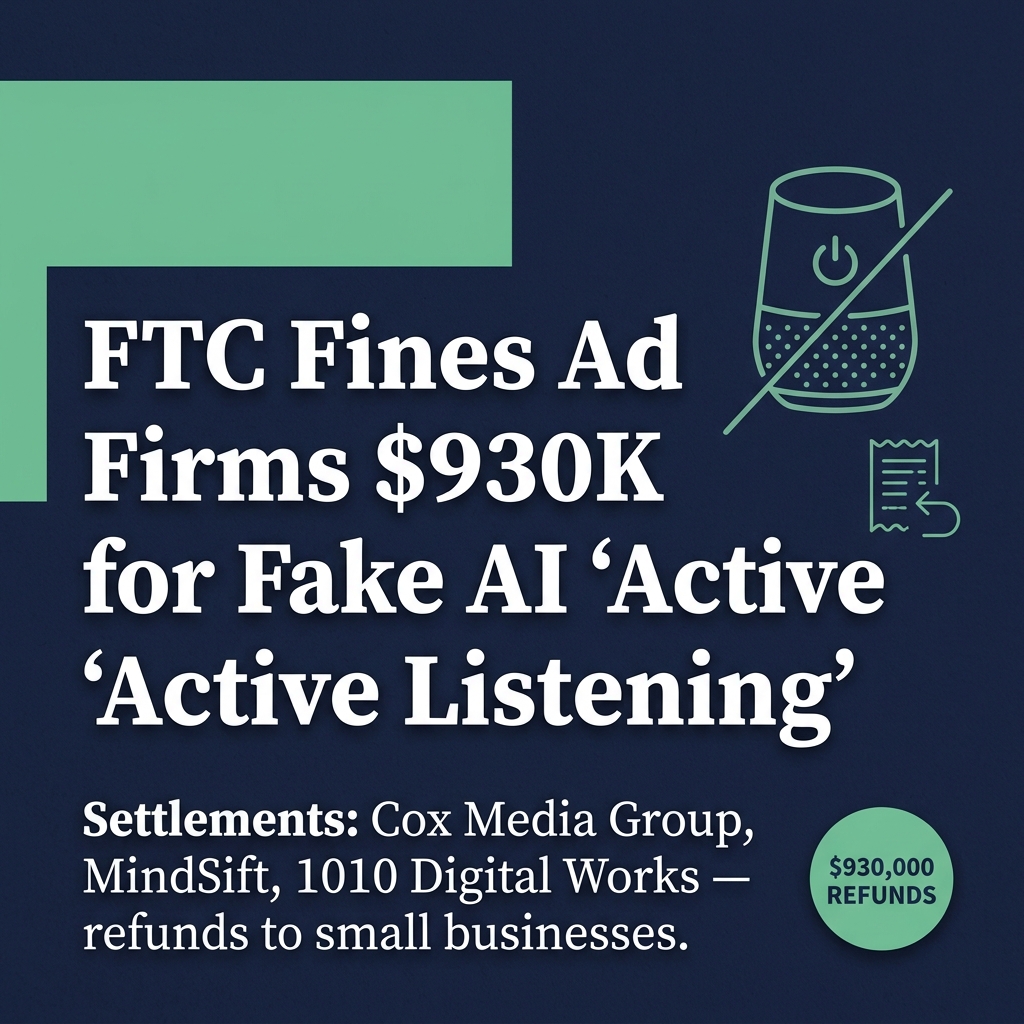
Small businesses that paid for a supposedly cutting-edge AI advertising tool got nothing but repackaged email lists at inflated prices. Now the Federal Trade Commission is forcing the companies behind the scam to pay $930,000 in refunds.
On August 27, the FTC gave final approval to settlement orders against Cox Media Group (CMG), MindSift LLC, and 1010 Digital Works LLC. The Commission voted 2-0 after a public comment period that drew two responses.
What the companies actually sold
The three firms marketed a product called “Active Listening” that claimed to use AI algorithms to capture conversations from consumers’ smart devices and then serve hyper-targeted local ads. CMG’s own website pitched it with the tagline “Don’t Just Know What They’re Searching For. Know What They’re Talking About.”
None of it was real. The FTC found the service collected no voice data at all. Instead, the companies resold email lists purchased from data brokers at a significant markup. The location targeting they promised was also inaccurate.
“Not only did the product these companies marketed not do what they claimed it did, but they also misled potential customers by claiming consumers had opted into this service when it’s clear they did not,” said Christopher Mufarrige, Director of the FTC’s Bureau of Consumer Protection, in the agency’s original announcement.
Who pays and who gets refunds
CMG owes $880,000 of the total. MindSift and 1010 Digital Works each owe $25,000. That money will fund refunds to the small businesses that bought the fake service.
All three companies are now permanently barred from misrepresenting what their ad products can do, how they collect voice data, whether consumers have consented, and how precisely their geographic targeting works. Any future violation of these consent orders could carry civil penalties of up to $53,088 per offense.
For small business owners shopping for marketing services, this case is a useful stress test for any vendor pitching AI-powered ad targeting. If a company cannot explain exactly what data it collects, how its models work, and what kind of results you should expect with specifics, treat that as a red flag. Ask for a small pilot before signing a long-term contract, and demand performance data you can independently verify.
The case also fits a broader FTC pattern. The agency has pursued similar actions against Air AI and DoNotPay over misleading AI claims in recent months. Vendors dressing up ordinary products with flashy AI language should expect more scrutiny, not less, going forward.
