

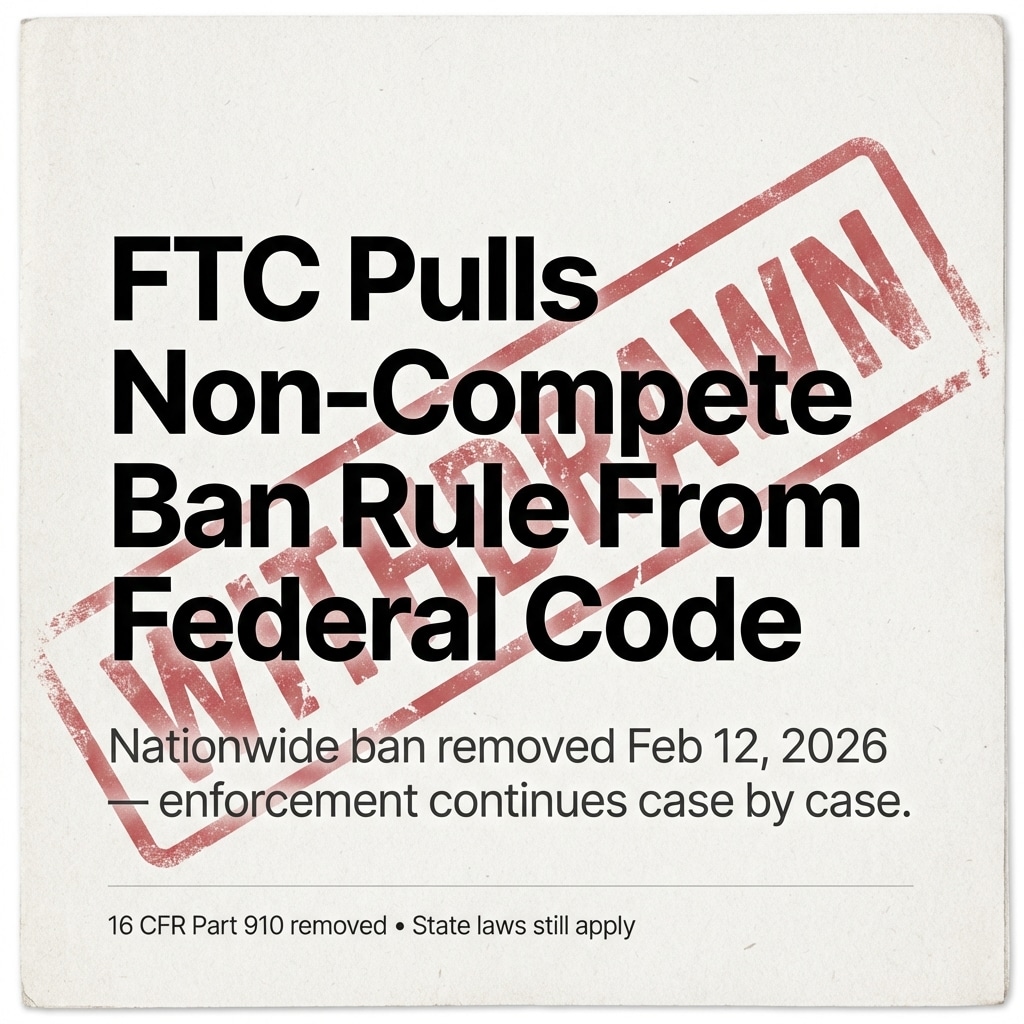
On February 12, 2026, the Federal Trade Commission officially removed its Non-Compete Clause Rule from the Code of Federal Regulations. The FTC published a final action in the Federal Register removing the rule (16 CFR Part 910), ending a Biden-era effort that would have banned most non-compete agreements nationwide. The rule was struck down before taking effect and has now been formally removed in a 3-1 FTC vote.
On September 5, 2025, the FTC voted 3-1 to dismiss its appeals, ending the legal battle. Federal courts in Texas and Florida had found the agency lacked the authority to issue a blanket ban. The FTC subsequently withdrew its notice of appeal on the grounds that “the Rule’s illegality was patently obvious.”
The ban is dead, but enforcement is not
If you use non-competes in your business, don’t treat this as an all-clear. Under the Trump-Vance administration, the FTC will attempt to reduce anticompetitive uses of noncompetes through its existing enforcement authority on a case-by-case basis. The agency is already acting on that promise.
The FTC negotiated a ten-year consent order with an employer to end its enforcement of blanket noncompete agreements against nearly 1,800 employees. That case involved a pet cremation company that applied identical non-competes to everyone from executives to hourly workers. In September 2025, the FTC also launched a public inquiry to gather information on noncompete practices to inform future enforcement actions.
At a January 27, 2026 workshop, the FTC made clear it will use its enforcement authority to eliminate non-competes that are overly broad, with resources focused on agreements that do not advance pro-competitive interests and are not narrowly tailored. The Commission will likely bring enforcement actions against employers who enforce noncompetes in particular industries, including healthcare, sectors where confidential information does not play a big role, and against employers who enforce noncompetes against low-wage employees.
What small business owners should do now
Non-compete enforceability remains governed by state law, and many states such as Colorado and Washington have recently passed their own income-based restrictions on noncompetes. Some states, including California, ban them outright. Arkansas, Indiana, and Maryland have passed laws banning noncompetes for physicians and nurses.
Employers should review their noncompete agreements to ensure they are narrowly tailored, including a reasonable time and scope, and limit the use of noncompetes to employees whose exposure to confidential information and trade secrets warrants the restriction. Firms are encouraged to ensure their nondisclosure and nonsolicitation agreements are narrowly tailored to protect legitimate business interests, as these remain the primary legal defense tools.
The practical takeaway is straightforward. Blanket non-competes applied to every employee, regardless of role, are now a target. If you rely on non-competes, talk with an employment attorney about whether a narrower tool like a non-solicitation or confidentiality agreement would do the same job with less risk. Keep an eye on your state’s rules, and monitor FTC enforcement updates at
