

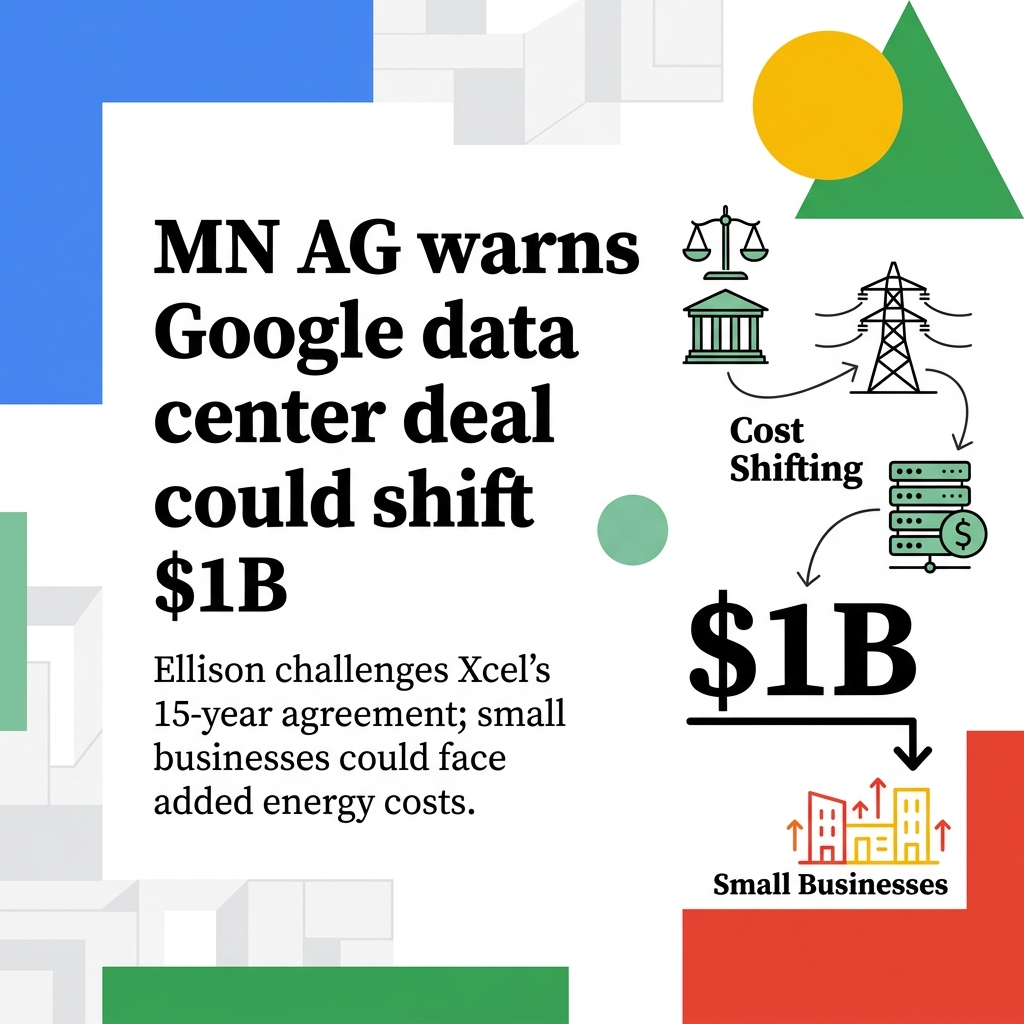
Xcel Energy says its proposed deal with Google will save other customers more than $1.1 billion. Minnesota Attorney General Keith Ellison’s office says its own analysis puts the figure closer to $1 billion in net costs to other ratepayers. That is a $2 billion gap in dueling projections, and Minnesota small businesses sit squarely in the middle of it.
On October 1, 2026, the AG’s office submitted initial comments to the Minnesota Public Utilities Commission challenging a 15-year electric service agreement between Xcel Energy and Google for a hyperscale data center in Pine Island, a small city in southeast Minnesota. The AG argues that Xcel has not established that the deal is reasonable, consistent with the public interest, or meets the requirements of applicable law.
A 2025 law is at the center of the fight
In 2025, Minnesota passed a law regulating data centers and how utilities provide them power, giving the PUC authority to approve, change, or reject deals between utilities and very large customers. That law requires “all costs attributable to the utility’s very large customers” be charged to those customers, not passed along to households or businesses.
Ellison’s office says Xcel has not shown that Google will pay all costs tied to the data center during the contract term. The agreement runs through Google’s subsidiary, Echo Zone LLC. The AG warns that potential stranded costs to Xcel’s individual and small-business customers could reach billions of dollars once the 15-year contract ends, particularly if Google reduces power consumption or exits the system early.
Adding to the concern, Xcel has redacted almost all of the dollar amounts showing potential cost impacts, making it difficult for the public to judge whether the deal adequately protects ratepayers.
Xcel and Google push back
An Xcel spokesperson called the AG’s comments “inconsistent with the facts in the docket,” saying the company “has made it clear that any large energy users, including data centers, need to pay their own way” without adding costs for other customers or affecting reliability.
Google claims the agreement is expected to provide about $1.1 billion in net benefits to other ratepayers over 15 years. The company has also pledged to fund roughly 1,900 megawatts of new wind, solar, and battery storage capacity.
For small businesses on Xcel’s Minnesota grid, the practical question is straightforward. If the PUC approves this agreement without stronger safeguards, and if the AG’s math is right instead of Xcel’s, electricity bills could rise to cover infrastructure built to serve a single giant customer. Business owners in Xcel’s service territory should watch the PUC proceedings and consider filing comments through local chambers of commerce or trade groups.
The PUC has not yet set a timeline for its decision, but both the AG and Xcel’s political opponent in a contested election year are applying pressure. During a debate on October 3, both Ellison and his Republican challenger agreed that the AG’s office should step in if a data center agreement forces energy costs onto Minnesota households. The outcome will likely set a precedent for every large data center deal that follows in the state.
