
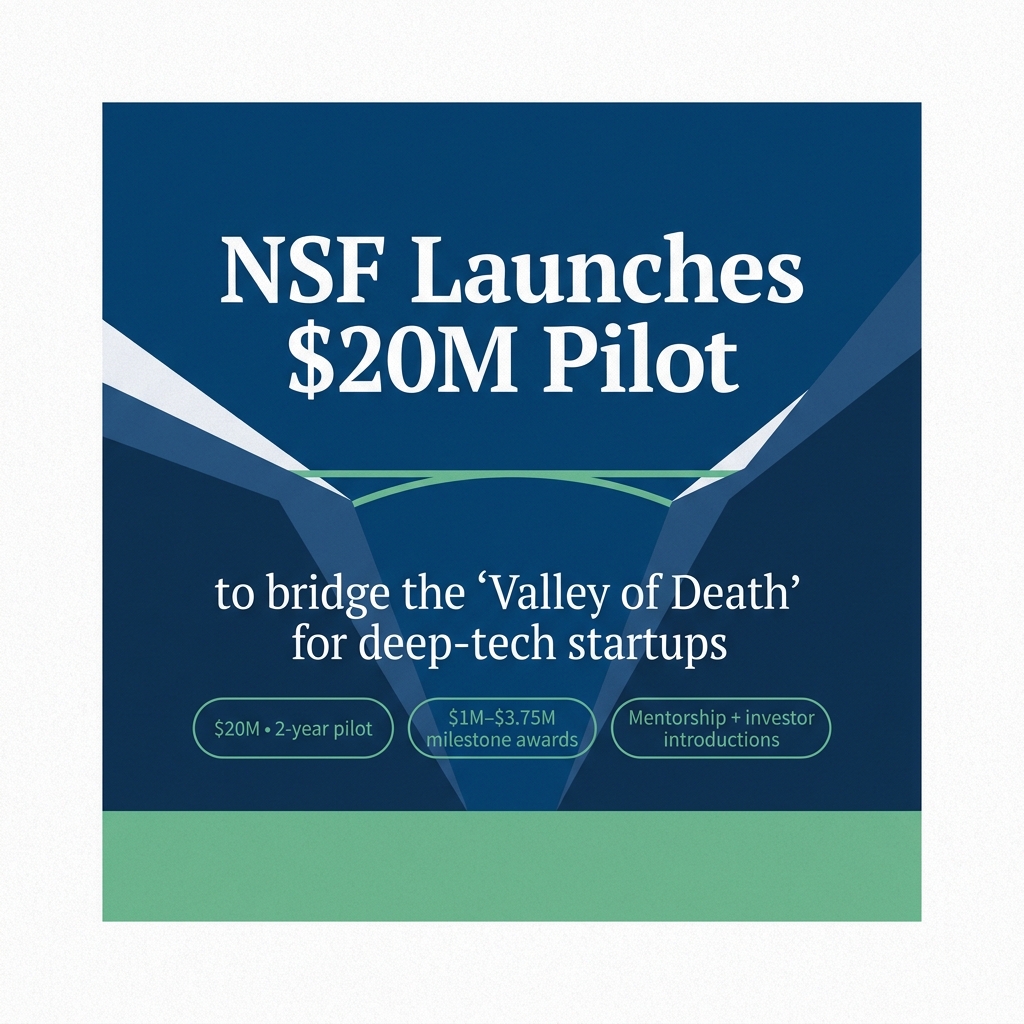
Most federally funded inventions never become products. The National Science Foundation just put $20 million behind an experiment to change that, launching a two-year pilot on September 14 that will funnel commercialization funding, mentorship, and investor introductions to small businesses stuck in the gap between a successful lab result and a viable company.
The pilot aims to address a persistent gap separating federally funded deep technology research from commercial success, a problem so common in research circles it has its own nickname.
Bridging the “valley of death”
“NSF invests in small businesses that bring the most innovative, cutting-edge technologies to the market,” said Erwin Gianchandani, NSF Assistant Director for Technology, Innovation and Partnerships. He added that by helping companies bridge the so-called “valley of death,” NSF can help more breakthrough innovations reach the market and strengthen U.S. economic growth.
Led by UCF’s National Commercialization and Translation Institute (NCTI), the pilot will provide and test the administration of commercialization funding, expert mentorship, and investor connections, while also evaluating which factors and approaches most effectively help deep technology companies reach the marketplace.
The program is aimed at small businesses that already hold NSF SBIR or STTR Phase II awards. Those are companies that have passed the initial research hurdle but still face the expensive, uncertain stretch between prototype and paying customer. The pilot was authorized under the NSF SBIR/STTR Commercialization Readiness Pilot Program.
What this means for deep-tech founders
This is non-dilutive money, meaning founders do not give up equity. NSF takes no equity and awardees keep full ownership of their company and intellectual property. For startups in fields like advanced materials, quantum computing, or biotech, that is a significant advantage over venture capital at a stage when valuations are uncertain.
The track record behind NSF’s broader small business programs makes the pilot worth watching. In recent years, $1.6 billion in NSF SBIR/STTR investments over a five-year period helped support startups in attracting more than $36 billion in subsequent funding. That is roughly an 18-to-1 leverage ratio on private capital.
The program is also a research study. The results will be used to establish and implement best practices in translating deep-tech into nationally impactful technologies. That means participants should expect data collection and evaluation requirements on top of their normal business operations.
With only $20 million in total funding spread across a two-year window, competition will be tight. Founders who already hold an NSF Phase II award should monitor UCF’s NCTI and NSF’s TIP directorate for formal application timelines and eligibility details, which have not yet been fully published.
