

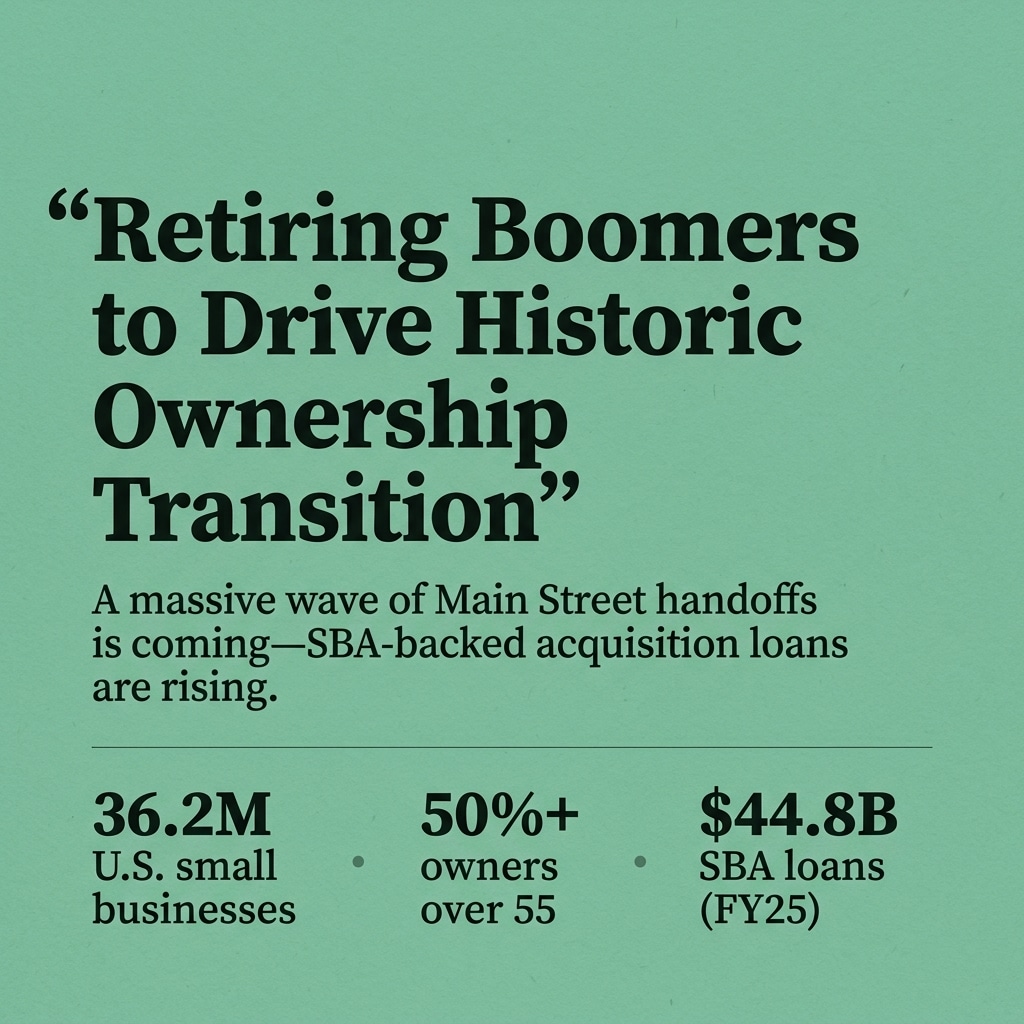
A new 40-page report from Contrarian Thinking, released May 11, 2026, puts data behind a trend that multiple research firms now agree on. The report examines the forces reshaping Main Street, from SBA lending patterns to buyer behavior and demographic changes, highlighting what may be one of the largest transfers of small business ownership in U.S. history.
The report estimates there are 36.2 million small businesses in the United States, representing 96% of all companies and accounting for a substantial share of private-sector employment. Today, more than half of all small-business owners in the United States are over the age of 55, up from roughly 30% in 2002.
That aging ownership base is not a niche concern. A separate McKinsey report projected that by 2035, about 6 million small and medium-size businesses will face ownership transitions as baby boomers retire. Those businesses represent up to $5 trillion in enterprise value.
On the financing side, government-backed lending hit record levels in the most recent fiscal year. In FY25, the SBA guaranteed 84,400 7(a) and 504 small business loans totaling $44.8 billion, including 6,750 504 loans for $7.8 billion and 77,600 7(a) loans for $37 billion. Contrarian Thinking said change-of-ownership loans are among the fastest-growing categories, a sign that more entrepreneurs are using SBA-backed financing to acquire established businesses rather than launch startups from scratch.
But record lending does not mean easy money. An SBA policy update in mid-2025 tightened underwriting standards, and a March 2026 change required lenders to stop using automated scoring for many loans in favor of full manual credit analysis. That means only buyers with solid financials and well-structured deals are likely to secure financing.
For anyone thinking about buying an existing business instead of starting one, the practical takeaway is straightforward. The supply of businesses for sale is growing, and government-backed financing exists to support acquisitions. But you will need clean personal finances, a clear deal structure, and professional help with due diligence. The vast majority of business owners do not have a succession plan in place, and many are finding it hard to find a buyer when they are ready to sell. That gap between sellers who need to exit and buyers who are prepared to close is where the opportunity sits.
For current owners approaching retirement, the data is a prompt to start succession planning now, not later. The full Contrarian Thinking report is available as a free download. McKinsey’s Great Ownership Transfer report offers additional analysis of which regions and industries face the highest transition risk.
