

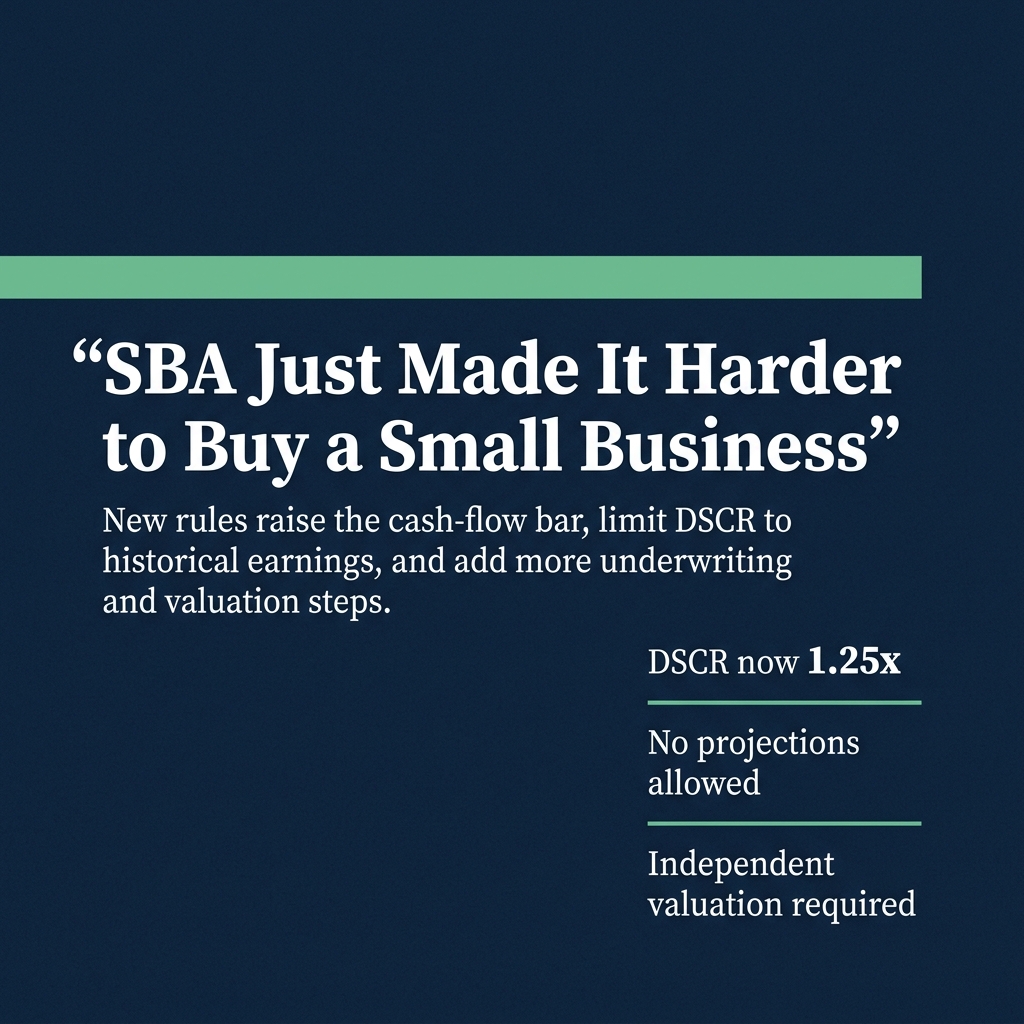
Buying a small business with an SBA loan just got meaningfully harder. On October 1, 2026, the agency’s new lending rulebook, SOP 50 10 8.1, took effect for all SBA 7(a) and 504 loans. It rewrites acquisition underwriting in ways that will shrink the size of deals many buyers can afford and slow closings across the board.
A higher cash-flow bar, no projections allowed
The minimum debt service coverage ratio (DSCR) for first-time acquisitions, owner buyouts, and ESOP transactions jumped from 1.15x to 1.25x. DSCR is a simple ratio of how much cash a business earns compared to what it owes in loan payments each year. At 1.25x, the business must generate $1.25 for every $1.00 in annual debt payments.
More importantly, that coverage must now come from historical or adjusted historical earnings, not projections. Under the old SOP, a buyer could pitch a growth story to bridge a coverage gap. That door is now closed. Business expansions, where an existing owner acquires a competitor, still qualify at the lower 1.15x standard.
Small deals lose their shortcut
Under the prior rules, acquisitions under a certain threshold could go through a lighter 7(a) Small Loan underwriting process. That option is gone. Every change-of-ownership deal, including those under $350,000, now goes through full Standard 7(a) underwriting, adding time and paperwork for the smallest transactions.
On valuations, the picture evolved right up to the deadline. The August draft of SOP 50 10 8.1 eliminated lender self-valuations entirely. But a September 25 technical update restored the option for deals with a business purchase price of $350,000 or less, as long as the buyer and seller are not closely related. Above that threshold, an independent valuation from a credentialed appraiser is required on every deal.
For larger transactions, there is yet another layer. Initial Acquisitions and Business Expansions priced at $3 million or more now require a lender-ordered Quality of Earnings (QoE) report on top of the valuation. A QoE is an independent check on whether the seller’s reported earnings are real and sustainable. The $3 million line is measured on the full purchase price before any buyer equity or seller financing, so deal restructuring will not sidestep it.
If you are buying or selling a business and the deal depends on SBA financing, the practical steps are straightforward. Have the lender run the 1.25x DSCR test on historical financials before you agree to a purchase price. Budget extra time for full underwriting and independent valuations. And for any deal near $3 million, build in calendar time and cost for the QoE report, which must be ordered by and prepared for the lender.
Sellers should pay attention too. Fewer buyers will clear the new coverage bar, especially for businesses with uneven recent earnings. Getting financials clean and reconciled before going to market is no longer optional. The SBA is watching lenders closely as the first wave of applications under the new rules starts moving through the system.
