

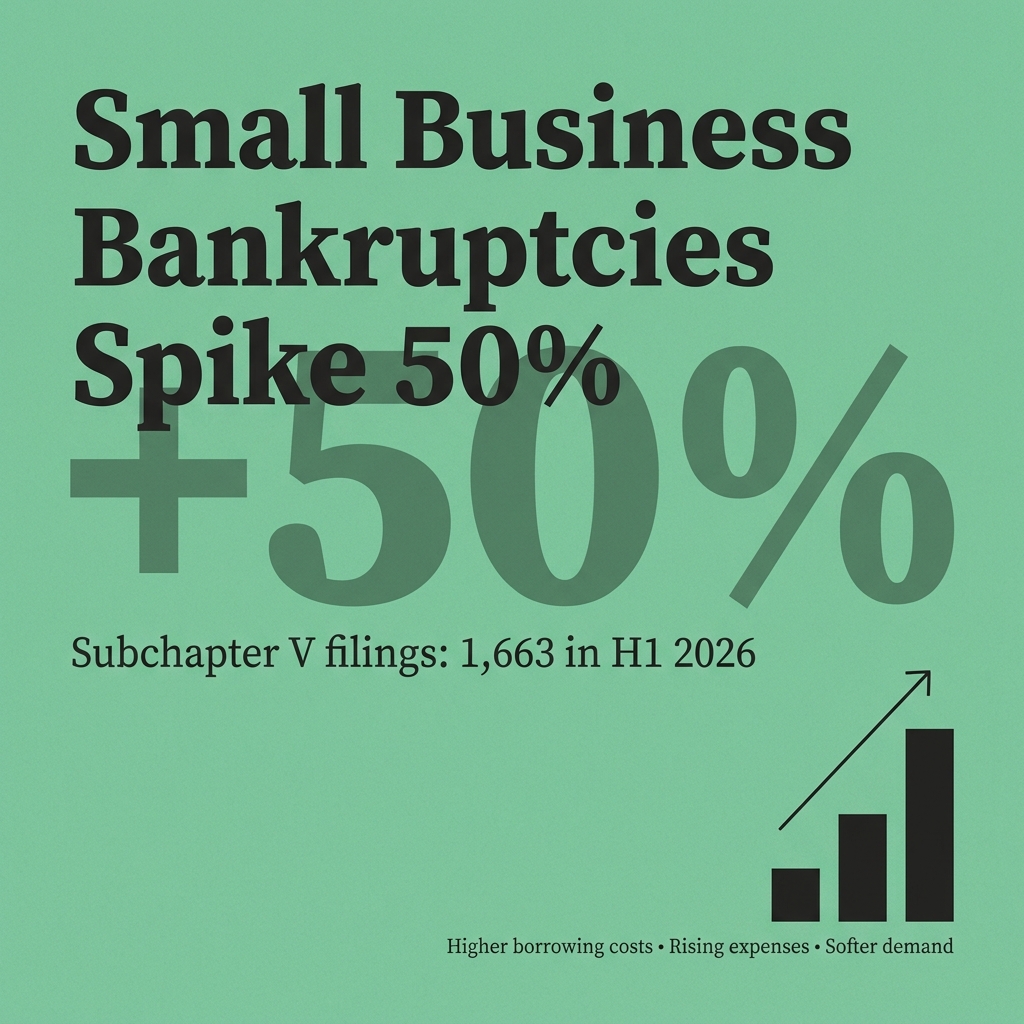
Some 1,663 small businesses elected Subchapter V bankruptcy in the first half of 2026, up 50% from 1,107 in the same period last year. That is the sharpest six-month jump since Congress created the streamlined small-business bankruptcy track in 2019.
The numbers, released July 8 by Epiq AACER in partnership with the American Bankruptcy Institute (ABI), cap a steady acceleration. Q1 alone saw a 67% year-over-year spike, with February filings nearly doubling compared to 2025.
“The 50% rise in Subchapter V elections underscores the mounting challenges facing small businesses amid higher borrowing costs and softening demand,” said Michael Hunter, Vice President of Epiq AACER.
The broader picture is just as rough
Total U.S. bankruptcy filings hit 310,550 in the first half, 12% above last year. Commercial Chapter 11 filings reached 4,589, a 28% increase. Every category of bankruptcy, consumer and commercial, trended higher.
Subchapter V is a simplified version of Chapter 11 reorganization designed for businesses with debts under roughly $3.4 million. It lets owners keep running the company, skip competing creditor plans, and typically wrap up in about 180 days. It is a restructuring tool, not a liquidation. The fact that so many owners are reaching for it tells you the financial stress has moved beyond tight margins into genuine distress.
What owners should watch
ABI Executive Director Amy Quackenboss attributed the trend to “higher borrowing costs, increasing expenses, and geopolitical volatility” pushing more debtors to seek court-supervised relief. That combination is unlikely to ease soon.
If your business is carrying high-rate debt and watching revenue soften, the data argues for acting early. Owners who run out of cash before filing lose most of Subchapter V’s advantages and may end up liquidating instead. Stress-testing cash flow now, renegotiating loan terms, and talking to restructuring counsel before a crisis hits gives you far more options than waiting.
On Capitol Hill, bipartisan legislation from Sen. Chuck Grassley and Rep. Ben Cline would permanently raise the Subchapter V debt limit to $7.5 million, potentially opening the door to many more businesses. Whether that bill advances before the filing trend worsens further is the next thing to watch.
