

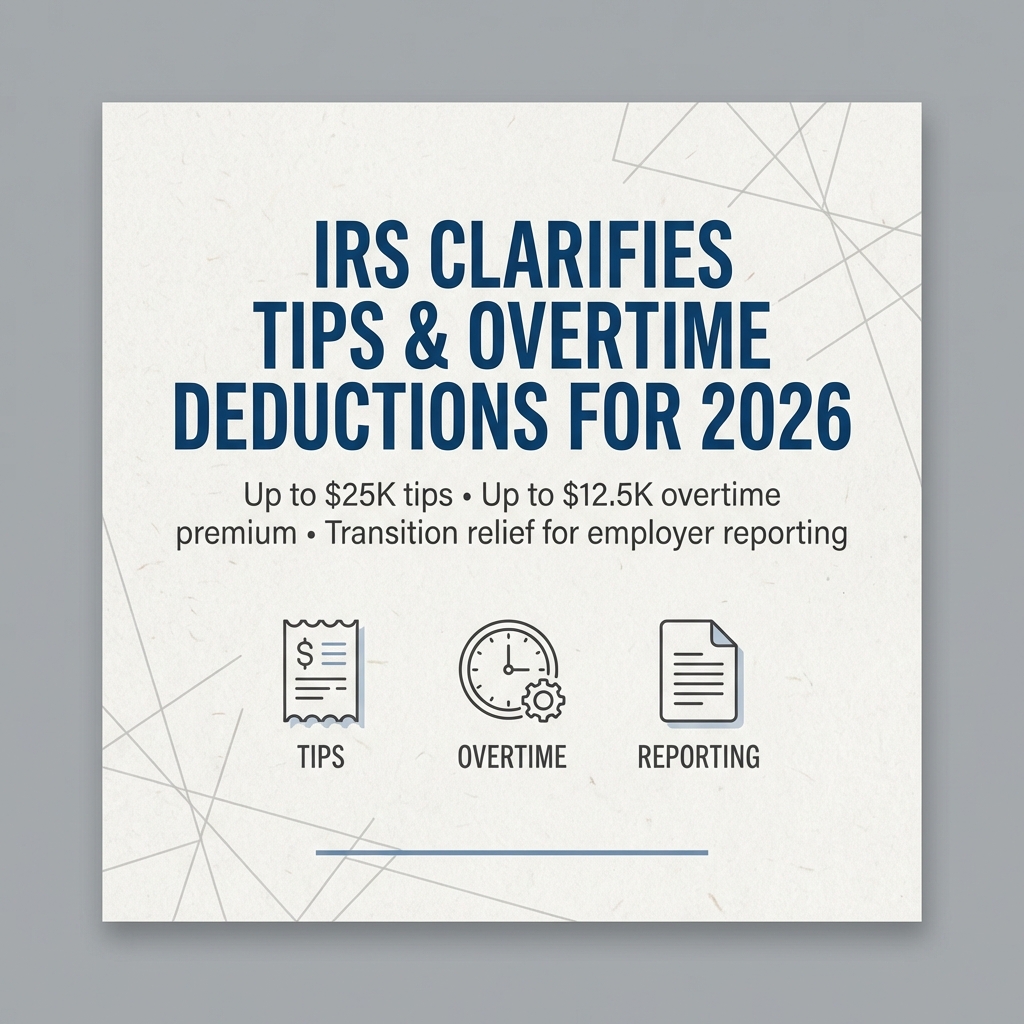
The IRS released new subregulatory guidance in mid-February 2026 explaining how workers can claim the new above-the-line deductions for qualified tips and qualified overtime on their 2026 filing season tax returns for tax year 2025 income. The guidance includes IRS Notice 2025-69 and related IRS FAQs that spell out what counts, how to calculate it, and how the deduction phases out at higher incomes.
For employees, the headline numbers are meaningful. Qualified tips can be deducted up to $25,000, and qualified overtime premium pay can be deducted up to $12,500 for single filers or $25,000 for joint filers, subject to phase-outs starting at modified adjusted gross income above $150,000 single or $300,000 joint. The IRS summarizes these worker provisions in its One Big Beautiful Bill provisions overview.
For employers with tipped or hourly teams, this is mostly a people and payroll communication play. When employees understand they may be able to deduct part of their tip income and overtime premium pay, it can improve perceived take-home pay and help retention, especially in restaurants, hospitality, personal services, and other overtime-heavy operations.
A key detail is what counts as qualified overtime. The IRS says it is limited to the premium portion required under the Fair Labor Standards Act for hours over 40 in a week, meaning the extra half in time-and-a-half, not the entire overtime wage. The IRS lays this out in its overtime deduction Q and A.
On the reporting side, the IRS also signaled transitional relief for employers as forms and systems catch up. For the transition year, the agency is encouraging reasonable, approximate information to help employees claim the deductions, with more formal separate reporting expected once updated W-2 and 1099 instructions are in place.
If you run payroll, consider a short internal memo to managers and a plain-language note to employees explaining what the deductions are, what you can and cannot provide, and where to find IRS guidance. If you use a POS or timekeeping system, confirm whether it can separate FLSA overtime premium pay from straight-time wages, since only the premium portion is eligible.
Two common pitfalls to flag for your team are income phase-outs for higher earners and confusion about what overtime qualifies under state law or union agreements. When in doubt, point employees to the primary IRS guidance in Notice 2025-69 and encourage them to consult a tax pro for their specific situation.
